
A grocery health score that shows its working.
A single number is only worth something if you can see where it came from. Most scores don't tell you, which makes them impossible to argue with — and impossible to trust.
Scan any barcode and HomeBasket gives the product a 0–100 score built from three things: its nutrition, the additives on its label, and whether it is certified organic. Tap the score and every one of those parts opens up, with the reasoning and the source behind it.
What goes into the number
Nutrition, on a published method
The nutrition part follows Nutri-Score, the peer-reviewed European method, including its separate table for drinks — so a sugary drink can't hide behind being low in calories.
Additives, with their sources
Additives found on the label are flagged with what they are and why they're noted, rather than presented as a bare warning. Where the ingredient data isn't good enough to judge, that part of the score abstains instead of guessing.
Organic, as a bonus only
Certification adds to a score. Its absence never subtracts — plenty of good food isn't certified, and treating that as a penalty would be a claim about the food that isn't true.
Where the data comes from
Nutrition facts come from the USDA's public food data, covering more than 13,000 foods, and package details come from open product databases. Both are sources you can look up yourself. Nothing in the score is a number we invented, and nothing is a number a model guessed.
The part most scores skip
An honest blank
Not every product has a complete label in any public database. When the data can't support a score, HomeBasket says “score unavailable” rather than filling the gap with an estimate. A wrong number is worse than no number, because you'd act on it.
Approximate means approximate
When a product is matched to a generic food rather than its exact label, the figures are marked as typical values rather than that product's own. You always know which one you're looking at.
Beyond a single scan
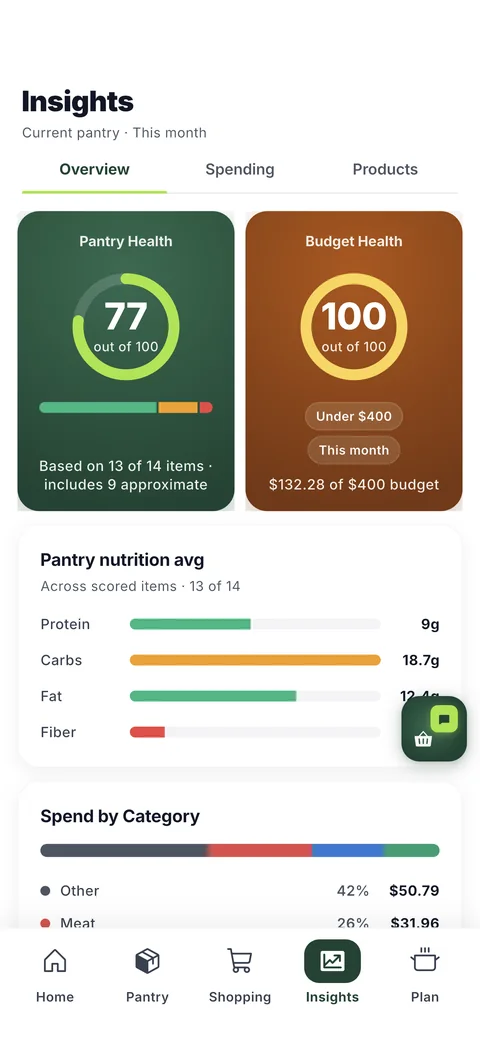
The same figures sit behind every item in your pantry, so you can see what you are actually buying over time rather than one product at a time — read from the receipts you already scan, with no food diary and no body data.
Questions
What is the score out of?
0 to 100. It combines nutrition, additives and organic certification, and you can open each part to see exactly how it contributed.
Why does a product say score unavailable?
Because the label data needed to score it honestly is missing from the public databases. HomeBasket would rather show a blank than invent a plausible number you might act on.
Is this the same as Nutri-Score?
The nutrition portion follows the Nutri-Score method, including its separate table for drinks. The overall 0-100 score also accounts for additives and organic certification, so the two are related but not identical.
Where do the nutrition facts come from?
The USDA's public food data for generic foods, and open product databases for packaged goods. Both are public sources you can verify independently.
Does it tell me if something is safe for an allergy?
No, and it never will. HomeBasket can warn you that a label declares an allergen, but it will not certify that anything is safe. Food labels and public databases are not a good enough basis for that promise.
Get early access
HomeBasket is in testing with a small group of households. Join the list and we'll tell you when it opens up.
Join the waitlistFree to start. Your receipts stay private to your household.
More about HomeBasket: Seeing the whole pantry's picture · Where the pantry comes from · Cooking from what you own · why we built it